What Makes Contemporary Neapolitan (Canotto) Crust So Airy
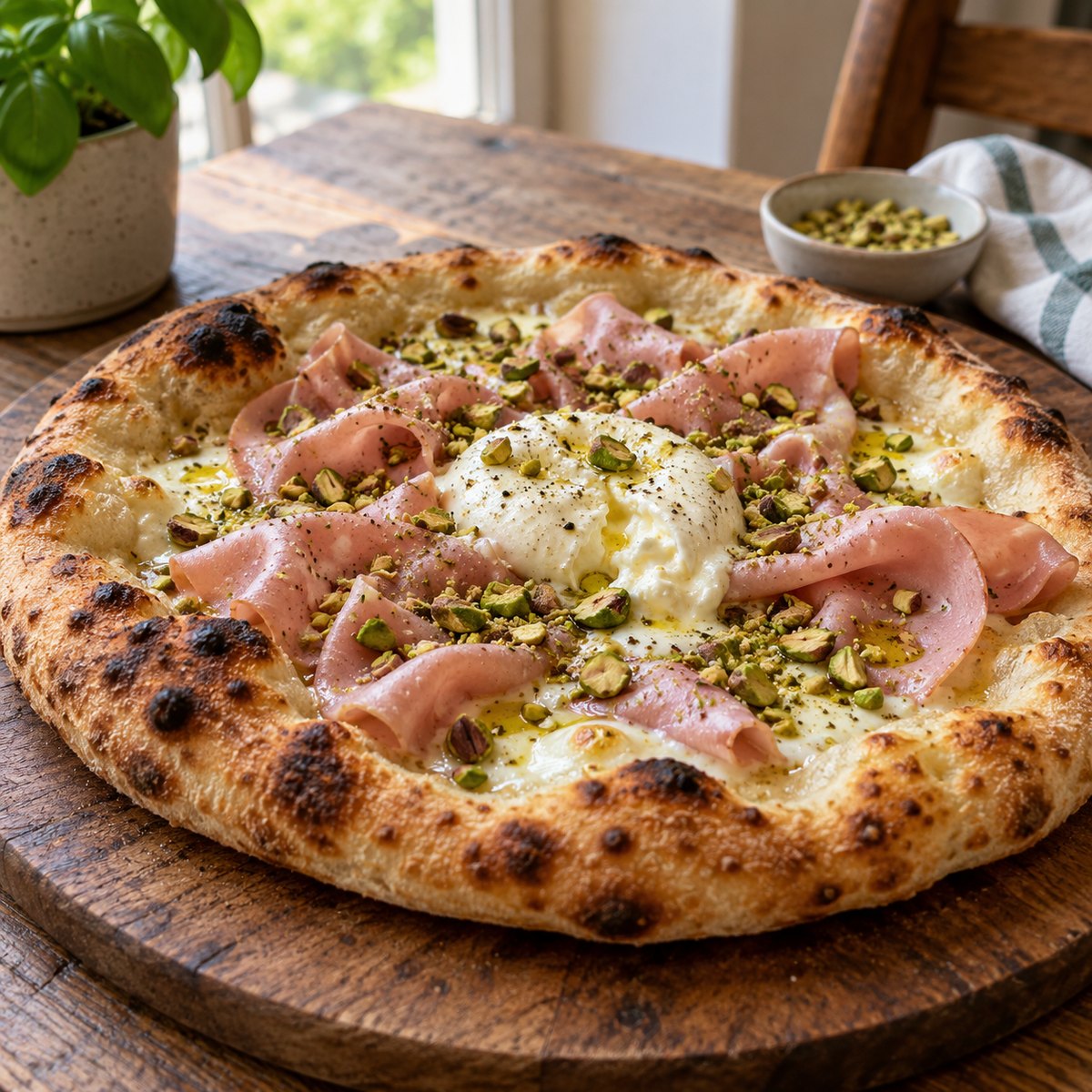
Unlike classic Neapolitan pizza with its thin, low-profile border, contemporary Neapolitan—often nicknamed canotto (“inflatable dinghy”)—features an exaggerated, crisp-shelled rim filled with delicate web-like alveoli. Achieving that without turning the crust tough or bready comes down to two levers: 70% final hydration and a liquid poolish preferment.
Because a poolish sits at 100% hydration with zero salt, yeast cells multiply smoothly while lactic acid bacteria and wheat enzymes break down complex proteins and starches. When that liquid starter is folded into the remaining flour the next day, the dough stretches like silk without snapping back, puffs rapidly under 430–450°C oven heat, and caramelizes into delicate golden blisters.
Understanding Poolish Math (30% Prefermented Flour Share)
The cleanest way to scale any poolish recipe is to define two ratios against your total batch flour (F) and finished dough hydration (H):
- Poolish Flour (Fp) =
0.30 × 621 g = 186 g(30% of all flour in the batch). - Poolish Water (Wp) =
1.00 × 186 g = 186 g(always 100% hydration for classic poolish). - Final Additions =
621 − 186 = 435 gremaining flour, and435 − 186 = 249 gremaining water.
Notice why checking the math prevents mistakes: Stage 1 and Stage 2 reconcile cleanly to 621 g total flour and 435 g total water (70%), with all 19 g of salt held strictly for Stage 2 so the poolish ferments freely overnight.
How to Read Poolish Ripeness (Visual Cues)
Because commercial yeast dosing in a preferment interacts closely with ambient kitchen warmth, treat the 12–14 hour clock as a window rather than an exact alarm. Look for three ripeness cues before starting Stage 2:
- Dome flattening: The poolish rises into a domed crown at peak activity, then begins to flatten right across the center with tiny dimples forming along the edges.
- Uniform surface bubbles: A lattice of fine, pearly bubbles covers the entire top and sides of the jar.
- Clean aroma: It smells sweet, malty, and faintly like plain yogurt—never sharply alcoholic or vinegary.
The 4-Factor Water Temperature Formula
In a direct dough, only room temperature, flour temperature, and mixer friction heat the dough. In a poolish dough, your matured starter (~372 g at 20–21°C) acts as a fourth thermal mass. Use the 4-factor estimate to calculate the water temperature needed to hit a 23–24°C finished dough:
Water °C = (4 × Target Dough °C) − Room °C − Flour °C − Poolish °C − Friction °C
Worked Example (Spiral Mixer): Target 24°C, Room 22°C, Flour 22°C, Poolish 21°C, Friction 14°C → (4 × 24) − 22 − 22 − 21 − 14 = 96 − 79 = 17°C water. Using a planetary mixer (higher friction ~16°C)? Aim for ~15°C chilled water. Mixing by hand (~5°C friction)? About 26°C water keeps the dough active.
Step-by-Step Guide: From Evening Poolish to Next-Night Bake
-
01Whisk the Stage 1 Poolish Night Before · 12–14h @ 20°C
Whisk 0.19 g instant dry yeast (or 0.56 g fresh yeast) into 186 g of 20°C water inside a tall clear container so you can see volume rise. Add 186 g strong Type 00 flour (W300–W330) and stir until completely smooth like thick pancake batter. Cover airtight and leave at ~20°C overnight.
-
02Disperse ripe poolish in cold water Next Day · 5 min
Once your poolish shows ripeness dimples and uniform bubbles, scrape all 372 g into your mixing bowl. Pour in roughly 200 g of your 249 g cold Stage 2 water (setting aside ~49 g for gradual addition) and whisk briefly to break up the starter.
-
03Develop gluten, stream reserve water & add salt 10–12 min
Add all 435 g of remaining flour and mix on low speed (or knead by hand) until the dough gathers into a cohesive, medium-firm mass. Once strands start forming, trickle in the reserved 49 g water a tablespoon at a time (bassinage) so the gluten absorbs every drop cleanly. With the final splash of water, sprinkle in 19 g fine sea salt and knead until smooth, elastic, and sitting around 23–24°C.
-
04Bulk rest with coil folds, then ball 2h bulk + 4h balled @ 20–21°C
Transfer the 70% dough to a lightly oiled tub. Rest covered for 2 hours total, performing two gentle coil folds at the 45-minute and 90-minute marks to align the gluten network. Turn onto a clean counter, divide into 4 portions (~269–270 g each), seal into smooth balls, and proof covered for 4 to 5 hours at 20–21°C until relaxed and airy.
-
05Gentle stretch & high-heat bake 75–90 sec @ 430–450°C
Drop a ball gently into semolina without deflating the edge gas. Use light palm-and-fingertip pressure from the middle outward, keeping a generous 2.5 cm rim untouched. For a signature contemporary white pie (like mortadella, stracciatella/burrata, and pistachio), bake the base with olive oil and fior di latte for 75–90 seconds at 430–450°C, then finish off the oven with cold cured meats, creamy burrata, and crushed pistachios.
Frequently Asked Questions
What happens if my poolish over-ferments and collapses?
If a poolish sits too long at warm temperatures, the dome sinks sharply, bubbles pop, and a strong sour or alcoholic smell appears as enzymes degrade gluten. If it has only just started dimpling, mix Stage 2 immediately using a slightly stronger flour (W300+); if it smells sharply vinegary and turns watery, start a fresh poolish so your final dough won’t tear.
Should I use 30%, 50%, or 100% poolish in pizza dough?
A 30% prefermented flour share is ideal for contemporary Neapolitan pizza: it creates light, open alveoli and crisp crust skin while keeping 70% fresh flour in Stage 2 for resilient gluten structure. At 50% poolish (100% hydration), total recipe hydration cannot be below 50% and the final dough is noticeably softer; 100% poolish requires 100% overall dough hydration, which is too liquid to stretch by hand.
Can I mature the poolish in the refrigerator instead of at 20°C?
Yes. Mix the poolish, leave it 1–2 hours at room temperature until early bubbles appear, then refrigerate at 4°C for 12–16 hours. Remember to plug that ~4–6°C starter temperature into the 4-factor water formula so your final mixing water warms slightly to compensate.